 PR_MC
PR_MCOverview of the Carpathian Regional Economic Development Zone Forum
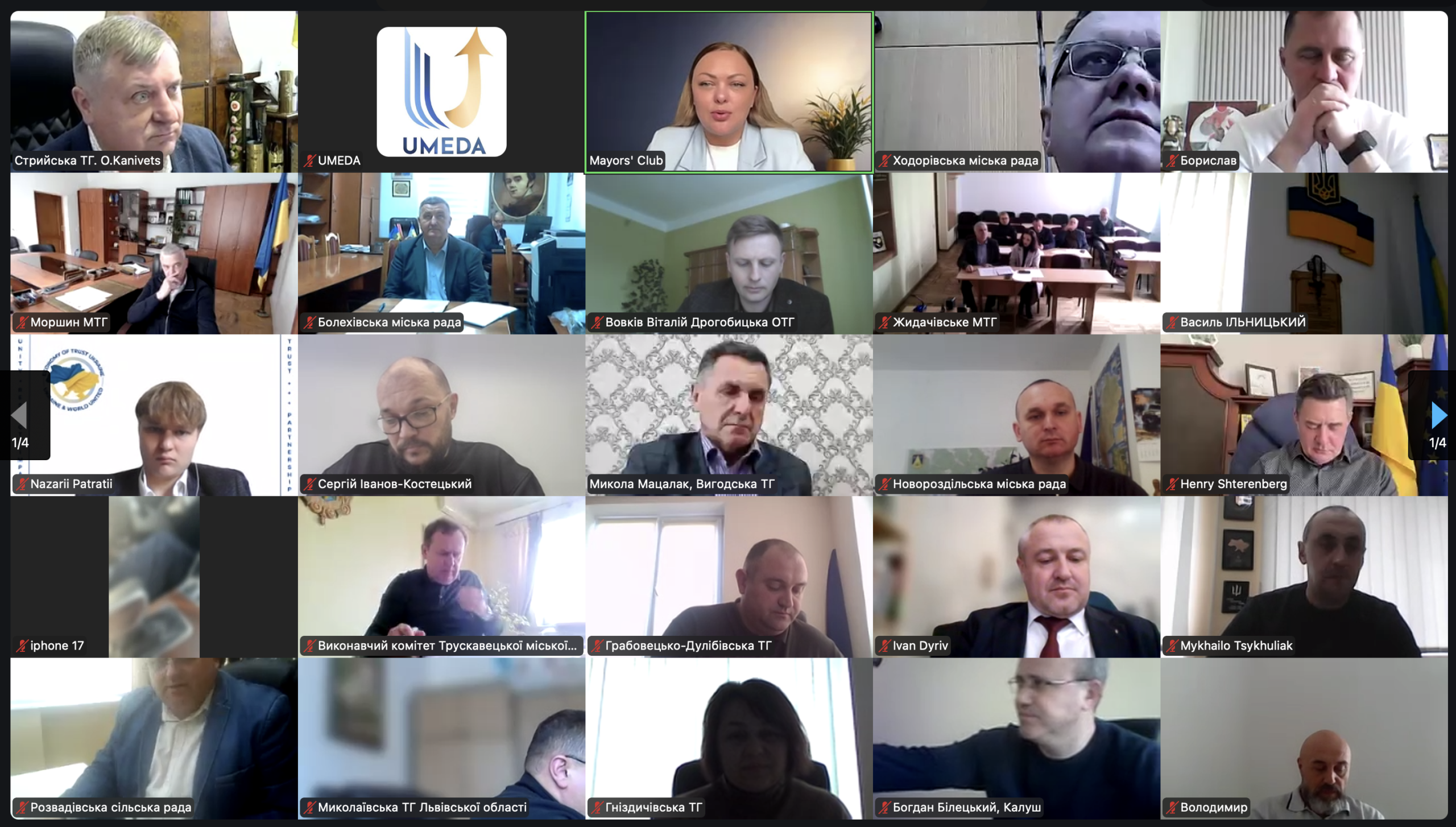
On March 23, 2026, the Carpathian Regional Economic Development Zone Forum took place, marking a historic launch of the first model of regional economic development in Ukraine. Within this initiative, 25 communities from the Lviv and Ivano-Frankivsk regions, together with representatives of local businesses and international partners, united to begin preparing real investment projects that will form the foundation of Ukraine’s future smart cities.
The online event was opened by Yuliya Chufistova, a member of the Presidium of the Mayors Club and Director of the UMEDA Development Agency. She emphasized that the Carpathian Regional Economic Development Zone (CREZ) is primarily being established as a practical tool for intermunicipal and business cooperation. The main goal is to develop well-structured, high-quality projects that are clear and attractive to donors, financial institutions, and private investors. She clearly noted that international interest in Ukraine already exists; however, communities are not yet ready to present themselves on a global platform. This was evident during previous REBIRTH OF UKRAINE trade missions, where Ukrainian communities and business representatives presented their potential to foreign stakeholders. External investors are willing to enter the Ukrainian market, but they expect to see realistic figures and clearly formulated proposals. Otherwise, interest remains just interest, without progressing into actual agreements.
Kristyna Zamula, Deputy Head of the Lviv Regional State Administration, also delivered a welcoming speech, emphasizing that this initiative fully aligns with the logic of regional development: communities should not compete with each other for limited resources, but rather cooperate to become stronger in their interaction with local businesses, particularly producers of Ukrainian goods.
Oleh Kanivets, Head of the Stryi community, which initiated the creation of CREZ, then highlighted that today no community in the region has sufficient scale or resources to independently implement large infrastructure projects or engage in serious negotiations with investors. Within a union of communities such as CREZ, this situation changes fundamentally, as a critical mass of projects is accelerated through joint efforts and shared capacities.
In contrast to the infrastructure and investment-focused discussions, Ihor Didkovskyi, founder of the «Rodovid» School, shifted the conversation toward human capital. He is convinced that any economic strategy must answer a simple question: for whom exactly is the future of these communities being created?
Reinforcing these points, Henry Shterenberg, CEO of Economy of Trust Ukraine (EoTU) and Head of the Investment Committee of the Mayors’ Club, presented the activities of Economy of Trust Ukraine, which brings together Ukrainian communities, business leaders from national and international companies, and investors to implement concrete projects, and introduced the concept of the CREZ model.
In preparation for the forum, EoTU experts managed to collect 951 project proposals from 11 CREZ communities, with a total estimated value of around $1 billion, while the average project value is approximately $8 million. Most of these materials are not yet полноценні investment products, but rather a collection of local initiatives that require substantial refinement and preparation for financing. This is precisely the purpose of CREZ – to serve as a platform that transforms a set of fragmented local needs into an investment-ready portfolio.
Henry Shterenberg also highlighted the Smart International Infrastructure Coalition (SIIC), a coalition of international companies that will be involved in the preparation and implementation of projects within CREZ. He identified 12 verticals, each of which is supported by professional teams ready to work together with communities on project development.
Right before the ceremonial signing of the Memorandum, three members of the Smart International Infrastructure Coalition delivered their speeches:
- Lasse Rajala, Director of International Operations at Sweco Finland Ltd, presented Sweco as Europe’s largest architectural and engineering consultancy, with 23,000 engineers and architects, offices in 15 countries, and around 150,000 projects annually, including 200 in Ukraine. He spoke about the importance of modernizing Ukraine’s outdated housing and infrastructure stock, highlighting the industrialization of construction amid labor shortages, as well as energy efficiency, circular economy principles, and the reuse of materials.
- Daniel Brandt, Senior Manager and Project Lead at Viaeuropa, introduced a new innovative model for local energy development. He presented the concept of an energy router – a solution that enables individual buildings to be connected into a shared energy exchange network, balancing consumption, storage, and generation, while reducing dependence on centralized grids.
- Camilla Khrulova, Founder and CEO of JC Environment AB, addressed water as a strategic resource for communities. She emphasized that modern water treatment and wastewater systems should be modular, compact, and easy to maintain. She also highlighted that effective water resource management can not only reduce costs but also unlock new economic opportunities.
The culmination of the event was the signing of a Memorandum of Cooperation between the communities within the Carpathian Regional Economic Development Zone. The signatories included the Stryi, Zhydachiv, Mykolaiv, Morshyn, Novyi Rozdil, Skole, Khodoriv, Hnizdychiv, Zhuravno, Slavske, Hrabovets-Duliby, Kozova, Rozvadiv, Trosnyk, Bolekhiv, Kalush, Dolyna, Broshniv-Osada, Vyhoda, Vytska, Boryslav, Drohobych, Truskavets, Medenychi, and Skhidnytsia communities. This moment transformed the forum from a discussion format into a formalized union.
Following the signing, a session of presentations by leading Ukrainian companies began, which may become practical implementers of future projects:
- Serhii Ivanov-Kostetskyi, founder and head of the architectural company «Creative», presented the company’s completed projects, emphasizing the critical importance of high-quality visualization of architectural solutions and thorough preparation of project documentation. He stressed that even the most promising idea cannot be implemented without professional, comprehensive and well-developed design work.
- Pavlo Kaiuk, co-owner and project curator at the Private Enterprise «Project Management Business Consulting (PMBC)», continued this topic, addressing it through the lens of financial modeling. He emphasized that for effective public-private partnership, a community must present not just a list of needs, but a clearly verified set of data: documentation, financial indicators, as well as realistic scenarios of project payback or social value.
- The session was concluded by Volodymyr Kostenko, Head of Development at URD Ukrainian Roads, a company with over 54 years of experience operating in 14 regions, with approximately 580 units of equipment, 20 plants, and laboratories. The company works not only in road construction but also in bridges, biogas facilities, foundations for wind energy, engineering networks, industrial and agricultural facilities, as well as waste management projects.
The financial block of the forum focused on a key issue: why communities fail to secure funding even when international partners are ready to provide resources for Ukraine’s recovery. Speakers emphasized that the main barrier is the lack of prepared, structured, and financeable projects:
- Sophie Tainer, Swedfund Project Accelerator, explained that their organization finances exclusively project preparation. These are grants for feasibility studies (FS), environmental assessments, analytics, and design work. The grants are awarded not to communities, but to consultants who prepare the documentation. The organization’s portfolio already includes more than 40 projects in Ukraine (covering water, energy, and digital infrastructure), some of which are already moving toward financing through the EIB, EBRD and NEFCO. The minimum viable scale is projects with investments starting from €5-10 million.
- Andrii Shestakov, expert consultant at the PPP Agency, spoke about the specifics of the new public-private partnership law. He noted that it opens opportunities not only for large-scale projects but also for smaller community initiatives. In particular, a threshold of around €5.538 million was mentioned, below which a project can be initiated with a conceptual note rather than a full pre-feasibility package. This means that many local infrastructure projects can theoretically be advanced faster if a community clearly formulates the project concept and finds a partner.
- Maher Chebbo, Managing Director for Europe at Univers, explained the financing structure of infrastructure projects: typically, it is not a single source, but a combination of instruments – blended finance (grants, loans, private capital), PPPs, donor funding, institutional investors (EIB, EBRD, World Bank), private equity, and green bonds.
- General John Wharton, Chairman and CEO of the Global Connective Center, noted that more than 80 funds worldwide are already ready to invest in Ukraine, but most community projects still remain at the level of a «wishlist». Investors require not declarations of needs, but bankable projects – with feasibility studies, a well-developed business model, and clear economics. He also stressed that large investors operate at scale, meaning individual communities are not attractive on their own; instead, consolidated projects at the level of economic unions are needed.
- Zoran Jeliс, EU project coordinator at the C.R.E.A.M. Europe PPP Alliance, explained how to make a project bankable through PPP mechanisms. He outlined three key challenges: security risks, weak institutional capacity of communities, and a financing gap. As a solution, he proposed a People-First PPP approach, where the starting point is not infrastructure itself, but the real needs of the community, which then shape a full financial model of the project. Financing is structured in three stages: first, preparation, usually covered by grants; second, the construction phase using pre-financing; and finally, long-term financing through refinancing mechanisms.
In conclusion, it can be confidently stated that the Carpathian Regional Economic Development Zone Forum marked the launch of a new model of cooperation between communities, businesses, and international partners, focused on practical project implementation and investment attraction.
The full video recording of the forum is available via the link.